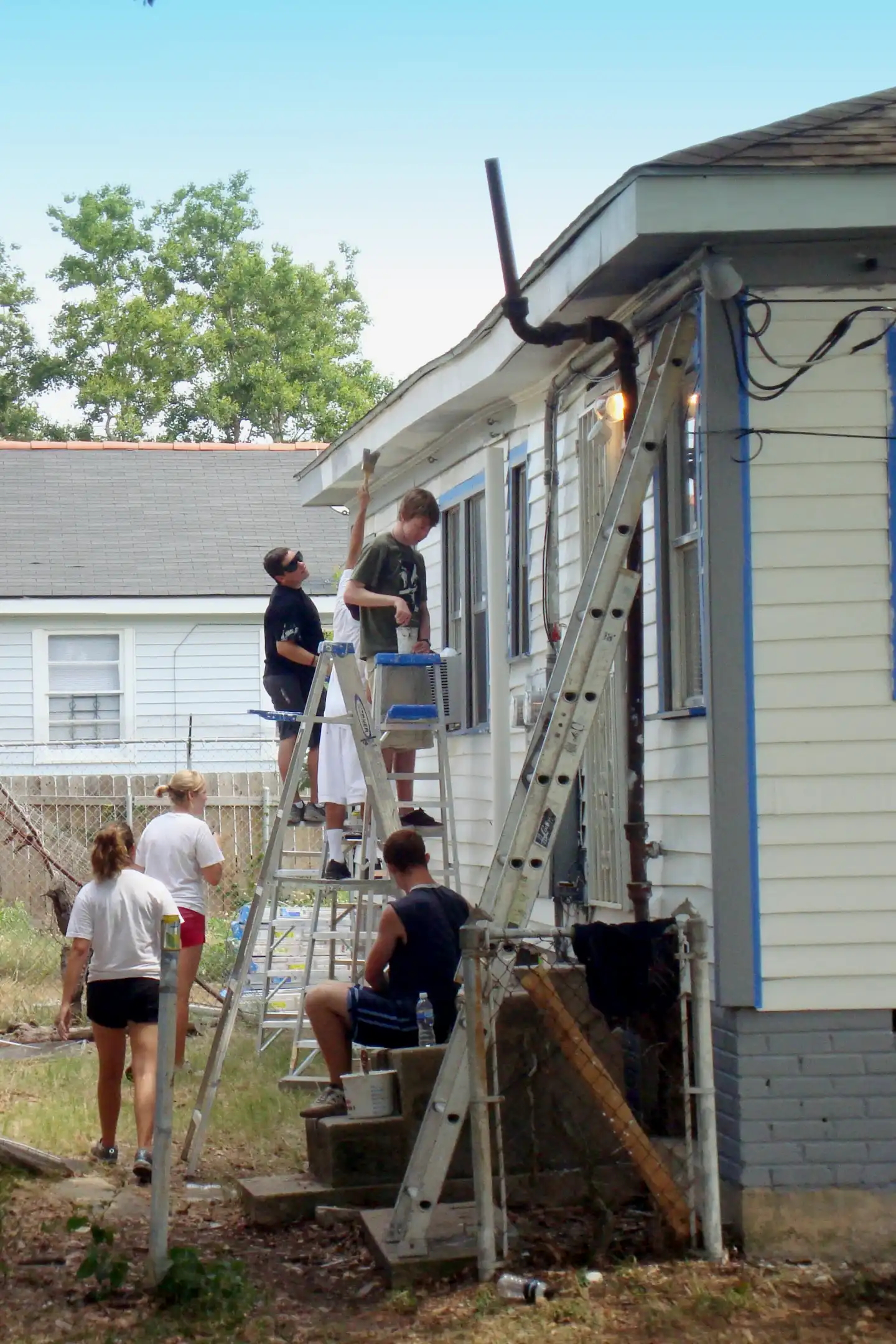
Grassroots organization Beacon of Hope brought neighbors together to rebuild following mass destruction by Hurricane Katrina, New Orleans, Louisiana.

Photo: Beacon of Hope, 2009

Beauty in the Built Environment & Community Resilience: Clark Visiting Scholars Study Group

  • Beauty in the built environment
  • third-realm beauty
  • community resilience
  • climate displacement
  • Beacon of Hope
  • post-disaster recovery
  • Hurricane Katrina

Summary

This study group session with visiting scholars at Clark University’s Integration and Belonging Hub explored how to use the post-Hurricane Katrina Beacon of Hope case study to identify and demonstrate implications for a policy brief on community resilience. Dr. Neumark and Stephanie Acker presented research on the role of home beautification in promoting community resilience in climate displacement contexts, drawing on Dr. Neumark’s 2014 interview with Denise Thornton (Beacon of Hope founder) and a follow-up July 2023 conversation with Denise Thornton, Dr. Neumark, and Stephanie Acker. The presentation demonstrated how Beacon of Hope’s grassroots initiative developed neighbourhoods through mapping conditions, educating residents, and empowering local leaders, with immediate attention to home beautification proving “key to everything.” Simple acts of landscaping, planting flowers, restoring shutters, and painting exterior walls helped residents recapture what was lost, signaled hope for rebuilding, attracted people back to neighbourhoods marked for destruction, and fostered community unity. Visiting scholars provided feedback emphasizing the importance of power dynamics and equity in community resilience, the need to pre-empt challenges related to post-disaster capitalism and neo-liberal planning, centring community and grassroots voices in all decision-making phases, and addressing the continuum from short-term shelter to permanent rehoming.

Key Takeaways

Community resilience in climate displacement contexts is multidimensional, relying on five key components: social capital (bonds, networks, and trust), supportive physical environment (beauty, functionality, dignity), economic recovery (livelihoods, resources, financial stability), psychosocial wellbeing (mental health support, coping mechanisms, emotional recovery), and inclusive decision-making, governance, and communication.

Beacon of Hope’s post-Hurricane Katrina success demonstrates that immediate attention to home beautification can be foundational for disaster recovery. Founder Denise Thornton stated this “was key to everything,” with simple acts like landscaping, planting flowers, restoring shutters, and painting exterior walls serving multiple critical functions: signaling hope for rebuilding, helping residents recapture what was lost, attracting people back to neighbourhoods marked for government destruction, and fostering community unity that inspired collective planning for return.

The visiting scholars emphasized that community resilience policy must address power, equity, and grassroots leadership. Effective policy briefs should explicitly address how power dynamics impact resource allocation in post-disaster contexts, pre-empt challenges related to post-disaster capitalism and neo-liberal beautification, centre community and grassroots voices in all decision-making phases, and address the full continuum from temporary shelter to permanent rehoming including both individual and communal spaces.

Implications for Practitioners

  • The study group explored community resilience as an interconnected system rather than a hierarchy of needs, examining how Beacon of Hope’s beautification approach simultaneously strengthened five interdependent components: social capital (neighbourhood bonds and trust), physical environment (dignity and visual coherence), economic recovery (local resources and stability), psychosocial wellbeing (emotional healing and hope), and inclusive governance (community-led decision-making). This framework challenges linear disaster recovery models that treat aesthetic considerations as secondary to material needs.
  • Beacon of Hope’s post-Hurricane Katrina success demonstrates that immediate attention to home beautification can be foundational for disaster recovery. Founder Denise Thornton stated this “was key to everything,” with simple acts like landscaping, planting flowers, restoring shutters, and painting exterior walls serving multiple critical functions: signaling hope for rebuilding, helping residents recapture what was lost, attracting people back to neighbourhoods marked for government destruction, and fostering community unity that inspired collective planning for return.
  • Visiting scholars emphasized that community resilience policy must address power, equity, and grassroots leadership. Effective policy briefs should explicitly address how power dynamics impact resource allocation in post-disaster contexts, pre-empt challenges related to post-disaster capitalism and neo-liberal beautification, centre community and grassroots voices in all decision-making phases, and address the full continuum from temporary shelter to permanent rehoming including both individual and communal spaces.